DeafBench
DeafBench checks whether speech recognition preserves the information a person actually needs—not only whether the words look close.
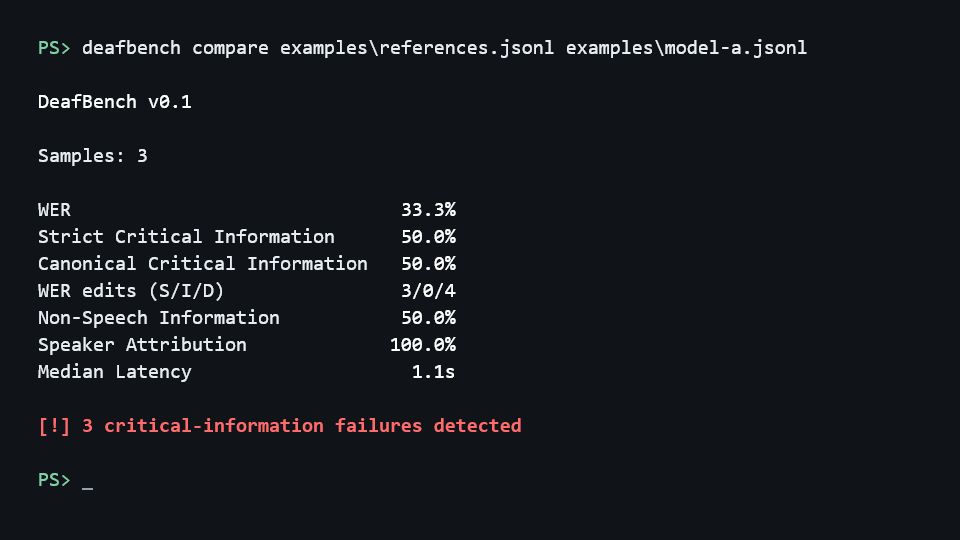
deafbench compare on the public example files.I build tools, test systems, and care about accessibility.
I’m Deaf. That shapes how I think about communication, details, and whether technology actually works for people.
DeafBench checks whether speech recognition preserves the information a person actually needs—not only whether the words look close.
deafbench compare on the public example files.I’m learning bug bounty work through authorized programs and safe labs. I want to find real problems, write them down clearly, and help get them fixed.
No testing without permission. No pretending a finding is bigger than the evidence.
I troubleshoot devices, accounts, and software. I also study how systems fail, then apply what I learn to safer setups and better explanations.
DeafBench results
These are recorded local observations on DeafBench synthetic-v2: 25 samples built around names, times, codes, addresses, and other details that matter. The metadata is published, but the sample-level run artifacts are not, so these values cannot be independently recomputed from this site or a repository checkout.
| Model | WER | Critical recall | Missed details |
|---|---|---|---|
| Granite Speech 4.1 2B | 18.9% | 91.9% | 5 |
| Parakeet TDT 0.6B v2 | 22.7% | 91.9% | 5 |
| Qwen3-ASR 0.6B | 26.6% | 90.3% | 6 |
| ARK-ASR 0.6B INT8 | 26.6% | 90.3% | 6 |
Canonical semantic recall is shown. These are local benchmark results, not endorsements or a public leaderboard ranking. See all integrated models and evidence boundaries.
Writing
Speech recognition can be technically close and still lose the one detail that matters.
A small test where 2.0% WER hid a complete failure to caption environmental sounds.
My rules for learning bug bounty work without crossing the line.
What I care about
Communication should be clear and inclusive. I build and test with Deaf and hard-of-hearing people in mind.
Security is about people and systems. I focus on practical fixes and plain explanations.
Small details change outcomes. I look closely, ask questions, and keep improving.